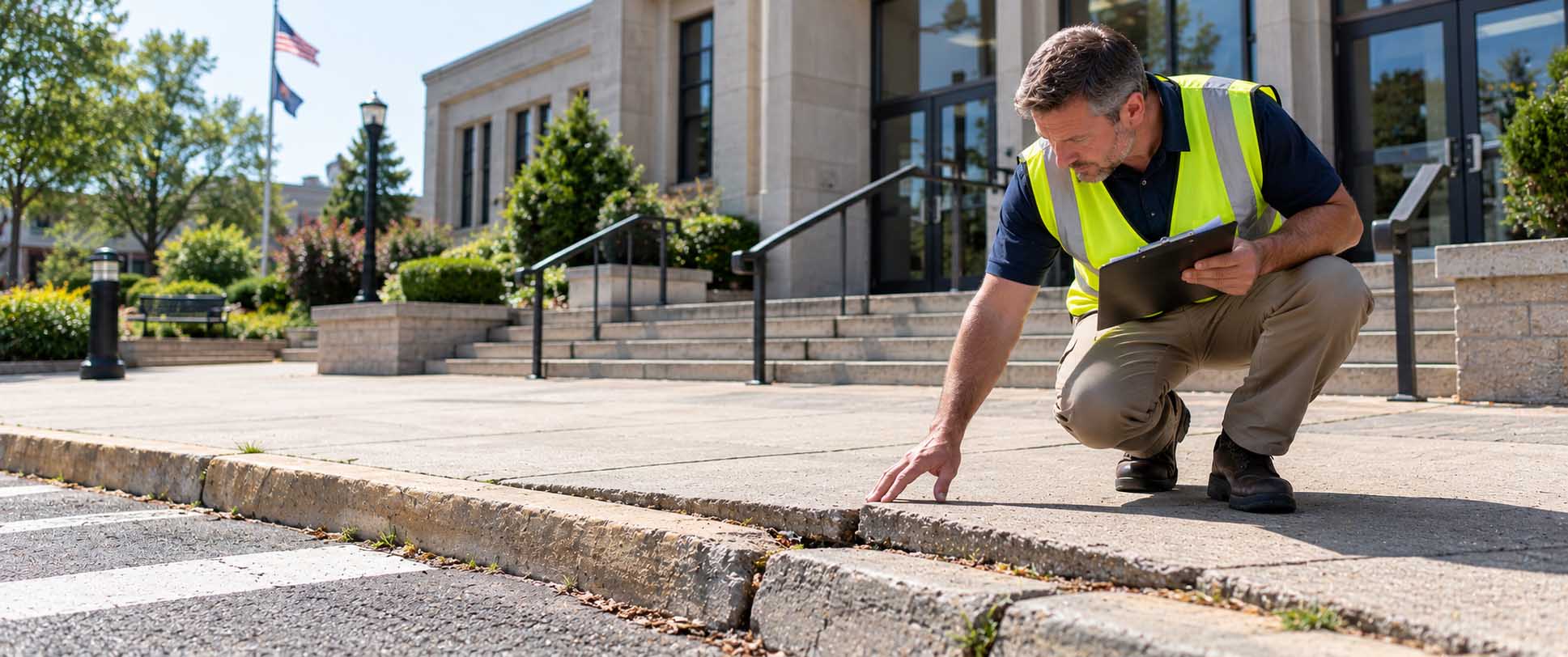
Accidents involving government property may raise different legal questions from injuries occurring on privately owned premises. Public sidewalks, municipal buildings, parks, and government-operated facilities can present hazards. However, determining legal responsibility often requires examining special rules governing public entities.
In New York, an injured person may need to identify the government body responsible for the location and comply with specific notice and filing requirements.
An accident on public property does not automatically establish government negligence. Instead, the property’s condition, maintenance responsibilities, available evidence, and applicable laws influence whether a claim may proceed.
What Are Accidents Involving Government Property?
These accidents involve injuries associated with property that a public entity owns, operates, maintains, or controls.
Examples may include:
- Falls on municipal sidewalks
- Injuries inside public buildings
- Accidents in government-operated parking areas
- Falls on public stairways
- Incidents involving damaged park walkways
- Injuries associated with unsafe public facilities
However, public access does not necessarily mean government ownership or responsibility.
For example, a walkway near a public building may fall under another entity’s maintenance responsibilities. Therefore, identifying the property’s ownership and maintenance arrangements is an important initial step.
Who May Be Liable for Government Property Accidents?
Potential responsibility depends on the government entity involved and the applicable legal framework.
Municipal Governments
Cities, towns, and villages may have responsibilities concerning certain public properties and facilities.
For example, a municipality may maintain a public building where an unsafe stairway condition allegedly causes an injury.
However, legal responsibility depends on the circumstances and applicable duties.
Counties and Other Public Entities
County-operated buildings, public facilities, and certain recreational areas may involve county authorities or other public organizations.
Different public entities may operate under different statutory requirements. Consequently, identifying the correct defendant can affect both liability and procedural obligations.
Private Contractors
Government entities sometimes hire private contractors to perform construction, cleaning, or maintenance work.
In certain circumstances, a contractor’s conduct may become relevant to an injury claim.
However, the existence of a government contract does not automatically establish contractor liability.
How Is Negligence Evaluated in Public Property Injury Claims?
Negligence generally requires establishing a legally recognized duty, breach, causation, and damages.
For example, an injured person may allege that a dangerous condition existed on a public walkway.
The legal analysis may then examine whether the responsible entity created the condition or had legally sufficient notice of it.
In addition, the claimant must establish that the condition caused the injury.
However, government defendants may have statutory defenses, immunity protections, or procedural requirements that differ from ordinary private-party claims.
Therefore, each case requires examination of the applicable law.
Accidents Involving Government Property in New York
New York law provides procedures for pursuing certain claims against government entities.
However, the applicable requirements depend on whether the defendant is a municipality, the State of New York, or another public organization.
For example, many municipal personal injury claims require a notice of claim within 90 days after the claim arises, subject to applicable exceptions.
Certain municipal claims also have shorter lawsuit deadlines than ordinary negligence actions against private defendants.
Individuals researching personal injury practice information can review the services offered by Siben & Siben, LLP, a law firm based in Bay Shore, New York.
For injuries occurring in Nassau County or Suffolk County, determining the correct public entity and applicable statutory procedures may be particularly important.
Notice-of-Claim Requirements for Government Property Injuries
A notice of claim is a formal document that certain laws require before an injured person can pursue a lawsuit against a public entity.
It generally provides information about the incident and the nature of the claim.
Depending on the applicable statute, relevant details may include:
- Claimant information
- Date and location of the incident
- General circumstances of the accident
- Nature of the alleged injuries
- Information required by the governing law
For example, New York General Municipal Law § 50-e establishes notice-of-claim procedures for certain claims involving public entities.
However, submitting a notice of claim is not the same as commencing a lawsuit. The claimant must also comply with applicable service and procedural requirements.
Therefore, an informal accident report should not be treated as a substitute for a legally required notice of claim.
Filing Deadlines for Claims Against Public Entities
Government injury claims do not all follow the same filing deadlines.
Instead, the applicable requirements depend on the public entity and legal basis of the claim.
For example, certain municipal claims involve notice-of-claim requirements and a one-year-and-90-day limitations period.
However, claims against New York State may proceed under different rules, including provisions of the Court of Claims Act.
Some claims may also involve special administrative procedures.
Consequently, a deadline applicable to one public entity should not automatically be applied to another.
Evidence Needed After Accidents on Government Property
Evidence can help establish the condition of the property and identify potentially responsible parties.
Relevant documentation may include:
- Photographs of the accident location
- Witness statements
- Incident reports
- Maintenance records
- Inspection documentation
- Relevant public records
- Surveillance footage
- Medical treatment records
For example, photographs of a damaged public staircase may help document the alleged hazard.
However, additional evidence may be necessary to establish notice, causation, and legal responsibility.
Why Prior Written Notice Rules Matter
Some New York municipalities have prior written notice laws concerning particular roadway, sidewalk, or similar defects.
These provisions may limit liability unless the municipality received the required written notice before the accident.
However, recognized exceptions may apply under certain circumstances.
For example, legal questions may arise when a municipality affirmatively creates a dangerous condition through negligent work.
The applicability of these rules depends on the governing statute and facts.
Therefore, the absence of prior written notice does not necessarily resolve every government property claim.
Can Government Immunity Affect an Injury Claim?
Yes. Government immunity principles may affect certain claims involving public entities.
For example, conduct involving discretionary governmental decision-making can raise different legal considerations from ordinary property maintenance.
However, immunity is not a universal defense to every accident occurring on government property.
The relevant analysis depends on the nature of the activity, applicable law, and specific circumstances.
As a result, ownership by a public entity alone does not determine whether immunity applies.
Final Thoughts
Accidents involving government property require careful attention to ownership, maintenance responsibilities, legal duties, and procedural requirements.
Unlike many private-property injury claims, cases involving public entities may require formal notices, shorter filing periods, and consideration of statutory defenses.
In addition, evidence concerning the hazardous condition and its connection to the injury remains essential.
Understanding these distinctions can help injured individuals recognize why identifying the responsible public entity and evaluating applicable legal requirements promptly are important steps in assessing a potential claim.