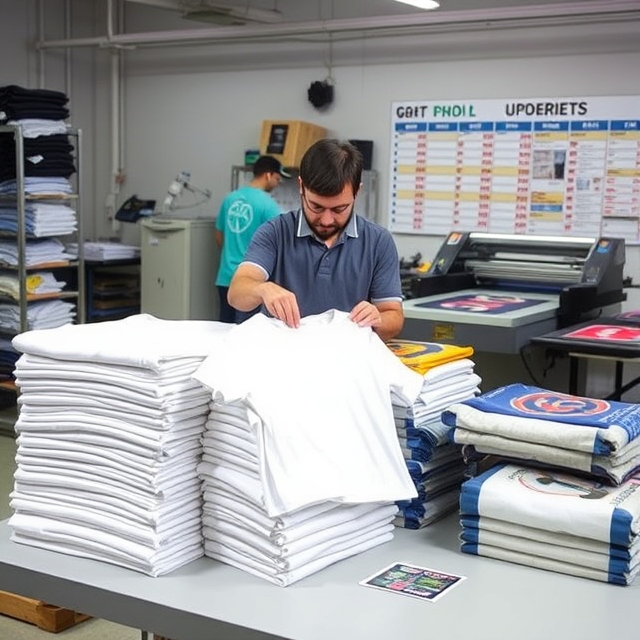
T-shirt printer capacity should match the amount of work you actually expect to produce. A machine that works well for occasional custom orders may not be suitable for a business handling daily batches, while a production-oriented setup can be unnecessary for a small operation. The right choice depends on order volume, print size, speed, workflow, and how much production you expect to handle as the business develops.
Why Production Volume Matters
Production volume describes how much printing a business needs to complete over a given period. For a custom apparel business, that might mean a few individual shirts each week, several orders per day, or larger batches for events, retailers, and organizations.
This matters because printers have different capabilities. Two machines may both produce high-quality garment graphics while being designed for very different workloads.
Before choosing equipment, consider:
- How many garments you expect to print
- Whether orders are individual pieces or batches
- The typical size of each design
- How frequently the printer will operate
- Whether demand changes significantly during busy periods
- How much workspace is available
- Whether production is expected to grow
The goal is not simply to find the fastest machine. It is to find equipment whose capabilities fit the entire production process.
T-Shirt Printer Capacity and Production Levels
A useful way to evaluate equipment is to divide production into broad operating levels.
Low-Volume Production
A small business, home-based operation, or creative studio may produce relatively small numbers of shirts. Orders might include personalized garments, samples, limited collections, or print-on-demand products.
At this level, flexibility and ease of operation can be more important than maximum production speed. A compact setup may also be easier to accommodate in a limited workspace.
The printer should still provide the required print quality and support the garments and designs being sold. However, purchasing equipment designed for much higher production can add unnecessary complexity and operating requirements.
Growing Production
As orders increase, production begins to depend more heavily on workflow efficiency. Instead of considering only whether a printer can produce a design, the business needs to consider how efficiently it can repeat that process.
Batch size becomes more important. Print speed, print area, software workflow, consumable handling, and the time required for finishing can all affect how many garments can move through production.
For a growing custom apparel business, it is useful to evaluate current demand alongside realistic near-term growth. Equipment that leaves some room for additional production can reduce the need to change the entire setup as order volumes develop.
Higher-Volume Production
Print shops and established apparel businesses may need equipment that can support more frequent production. At this level, capacity is closely connected to workflow.
A printer with a suitable print width can reduce the need to work around unnecessarily small print areas. Consistent operation can also become more important when multiple orders must be processed within the same working period.
However, maximum advertised speed should not be treated as the only measure of capacity. The complete production cycle includes preparation, printing, curing or transfer steps where applicable, garment pressing, inspection, and packaging.
Look Beyond Print Speed
Print speed is an important specification, but it does not tell the whole story.
Suppose a printer produces a design quickly but requires significant preparation or finishing time. The overall workflow may still be slower than expected. Similarly, a machine with a larger print area may be more practical for certain designs even if its nominal speed is not the highest available.
When comparing equipment, look at:
- Print speed
- Maximum print area
- Print resolution
- Printhead configuration
- Ink requirements
- Compatible garment types
- Software and RIP workflow
- Maintenance requirements
- Heat-press or transfer requirements
- Workspace requirements
For businesses comparing equipment by production needs, a broader range of garment printer for small business options can be useful when evaluating differences in size, configuration, and intended workflow.
Consider the Complete Production Workflow
A printer rarely operates as an isolated piece of equipment.
For example, a DTF workflow can involve artwork preparation, printing onto transfer film, applying adhesive powder, curing the transfer, heat pressing it onto the garment, and inspecting the finished product. DTG production has a different workflow that can include garment pretreatment, direct printing, and curing.
Because of these differences, production capacity should be considered across the complete process.
If the printer can produce designs faster than the heat press can finish them, the press may become the bottleneck. If printing is fast but artwork preparation takes too long, increasing printer speed may have limited practical value.
Mapping the complete workflow can reveal where additional capacity would actually make a difference.
Print Width Can Affect Productivity
Print width is another important consideration when matching equipment to production.
A small print area may be sufficient for logos, names, and simple front designs. Larger artwork may require a wider configuration or multiple positioning steps.
The most suitable print area depends on the products being sold. A business specializing in small chest logos has different requirements from one producing large front graphics on T-shirts and hoodies.
Therefore, compare the printer’s usable print area with the designs that make up most of the expected orders.
Plan for Busy Periods
Production demand is rarely identical every day. A custom apparel business may experience increases around holidays, events, promotions, school activities, or seasonal product launches.
This makes peak workload an important part of equipment planning.
A setup that handles normal production comfortably may become difficult to manage when several large orders arrive simultaneously. On the other hand, buying equipment solely for an occasional peak can create unnecessary costs during quieter periods.
A practical approach is to examine typical workload, expected growth, and occasional peak demand separately.
Match Equipment to the Business Model
Different apparel businesses have different capacity requirements.
A print-on-demand seller may process individual orders with varied artwork. A local custom-printing service may receive batches of shirts for businesses or events. A clothing brand may repeatedly produce the same designs in larger quantities.
Each model places different demands on the printer and workflow.
For example, a business producing highly varied personalized orders may value flexibility, while a business repeatedly producing larger batches may place greater emphasis on throughput and repeatability.
Questions to Ask Before Choosing
Before purchasing a T-shirt printer, ask:
- How many garments do I realistically expect to print?
- What is the average size of my designs?
- Will most orders be single garments or batches?
- Which fabrics will I print on?
- Do I need DTF, DTG, sublimation, or another process?
- What other equipment is required to complete the workflow?
- How much workspace can I dedicate to production?
- What happens if order volume increases?
- Which part of the workflow is likely to become the bottleneck?
- What maintenance and consumables will the setup require?
These questions provide a more useful basis for equipment selection than comparing one specification in isolation.
Capacity Should Support Sustainable Growth
Choosing equipment according to production volume is ultimately about creating a workable production system. A small operation does not necessarily need the same setup as a busy print shop, and higher capacity is not automatically better if the business cannot use it efficiently.
Instead, consider current demand, expected growth, garment types, design sizes, workflow requirements, and peak workloads together. By matching printer capacity to the actual production model, an apparel business can build a setup that is practical today while leaving an appropriate path for future growth.